

Release time:2012-01-20
Specific LAL Reagent
G Factor-free LAL Reagent · Specific Endotoxin Detection
Specific LAL Reagent is a product originally developed by our company in China. It is also known as G Factor-free LAL Reagent, Specific Endotoxin Detection Reagent, or TAL-ES-Test.
Development of the LAL Test
In the 1960s, American scientists Levin and Bang discovered that endotoxins from Gram-negative bacteria can rapidly induce coagulation of horseshoe crab amebocyte lysate. Based on this discovery, the LAL test, a highly sensitive and specific method for endotoxin detection, was developed and subsequently adopted worldwide.
However, during the application of LAL reagents, false-positive reactions, also known as gel reactions caused by non-endotoxin factors, were sometimes observed, creating challenges for the application of the LAL test. To address this problem, extensive research and improvements were carried out from the 1980s onward.
Discovery of β-D-Glucan Interference
In 1981, Kakinuma discovered that (1,3)-β-D-glucan (β-glucan) could cause LAL reagents to coagulate. This substance is widely present in the cellular components of basidiomycetes, fungi, lichens, yeasts, and algae. At a concentration of only 10 ng/mL, it can cause LAL reagents to form a gel.
Similar substances are also present in some artificial kidney dialysis membranes made from synthetic fibers. These substances can interfere with the LAL test but do not cause an increase in body temperature in rabbits.
Mechanism of the LAL Test
Subsequently, Japanese researchers successively discovered and purified proclotting enzyme, coagulogen, Factor B, Factor C, Factor G, anti-lipopolysaccharide factor, and other components, thereby elucidating the mechanism of the LAL test.
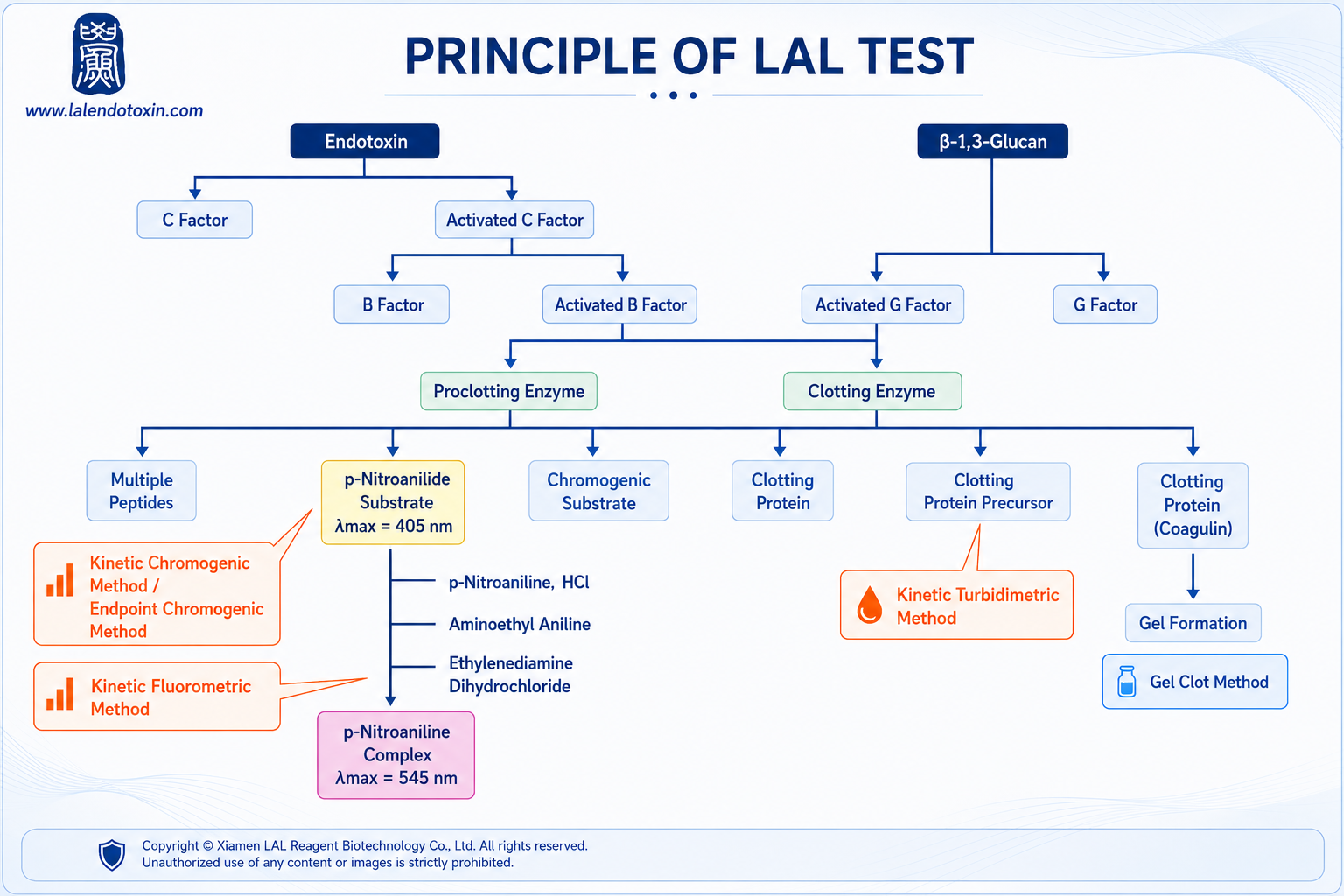
Development of Specific Endotoxin Detection Reagents
To eliminate interference from the bypass pathway in which (1,3)-β-D-glucan activates Factor G and to make the LAL reagent react specifically with endotoxins, Japanese researchers developed specific endotoxin detection reagents.
In 1985, Kobayashi developed a method based on recombinant horseshoe crab coagulation enzymes, and in 1990, Tsuchiya proposed a method using carboxymethyl curdlan to block the Factor G pathway.
Development of the Specific LAL Reagent
Based on many years of research, including the work published in the sixth issue of Modern Applied Pharmacy in 1987, our factory began mass production of a new generation of Specific LAL Reagent in the spring of 1995 and introduced it to the market.
This LAL reagent reacts specifically with endotoxins and does not react with (1,3)-β-D-glucan. When testing pharmaceuticals, biological products, and clinical blood samples, it helps avoid false-positive reactions and provides more accurate and reliable test results.
Factor G Pathway Control Test
For the convenience of users, in addition to the original endotoxin working standard, (1,3)-β-D-glucan is also provided as a control for detecting interference from the Factor G pathway.
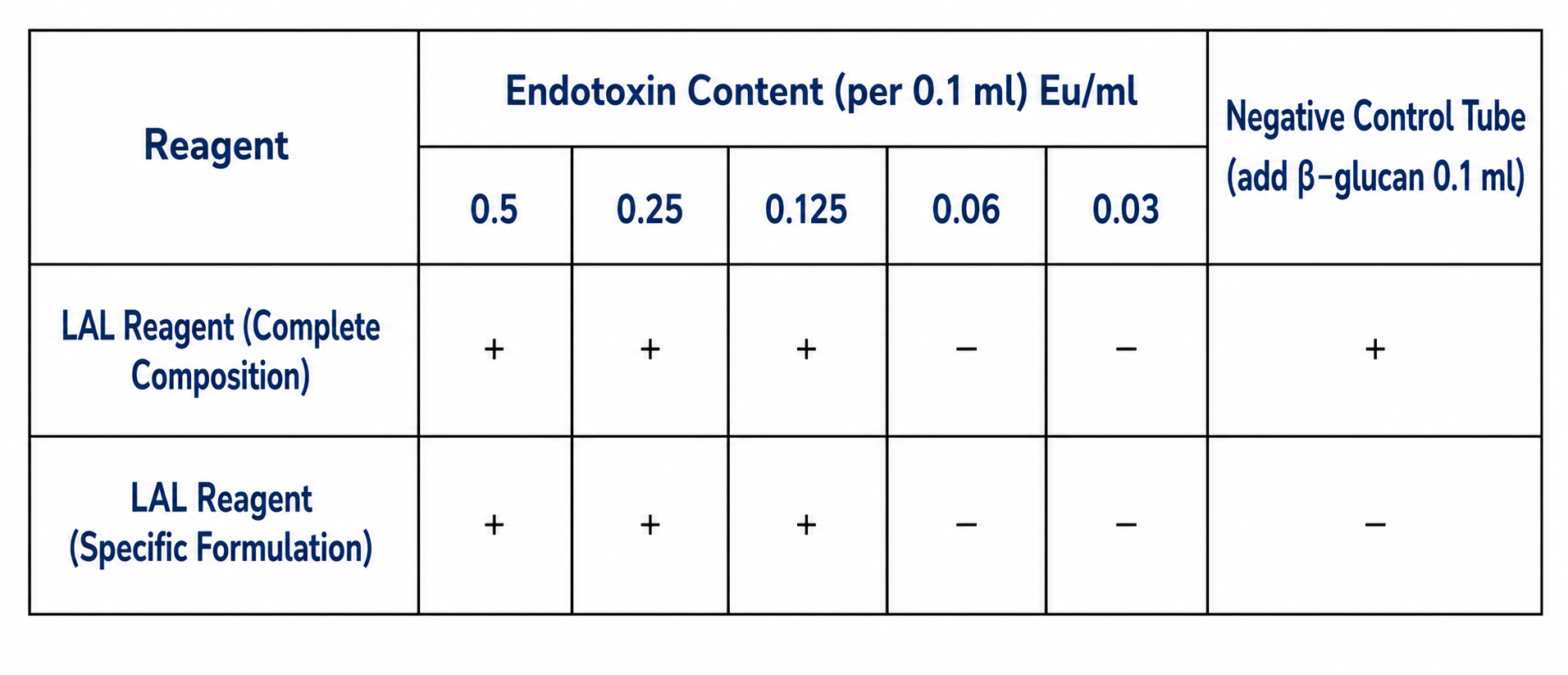
Note: Assume that the sensitivities of the two LAL reagents used are both 0.125 EU/mL. First, reconstitute the reagents with the appropriate lysate solvent. Add 0.1 mL of each reagent to the corresponding tube, followed by 0.1 mL of endotoxin and 0.1 mL of (1,3)-β-D-glucan for the blank control. Mix thoroughly and incubate in a 37°C water bath for 1 hour. Remove the tubes and evaluate the results.
The blank control containing the conventional LAL reagent produces a positive result because it contains Factor G, which is activated by (1,3)-β-D-glucan, resulting in gel formation. In contrast, the Specific LAL Reagent is not activated by (1,3)-β-D-glucan and therefore does not form a gel. It reacts specifically with endotoxins.
Identification of Specific LAL Reagent
Add 0.1 mL of β-glucan separately to 0.1 mL of reconstituted conventional LAL reagent or Specific LAL Reagent. Note: The sensitivities of the conventional LAL reagent and the Specific LAL Reagent should be the same. Mix thoroughly and incubate at 37 ± 1°C for 1 hour. Remove the tubes and evaluate the results.
The conventional LAL reagent produces a positive result because its Factor G bypass pathway is activated by β-glucan, resulting in gel formation. The Specific LAL Reagent is not activated by β-glucan and reacts specifically with endotoxins, so no gel is formed.