

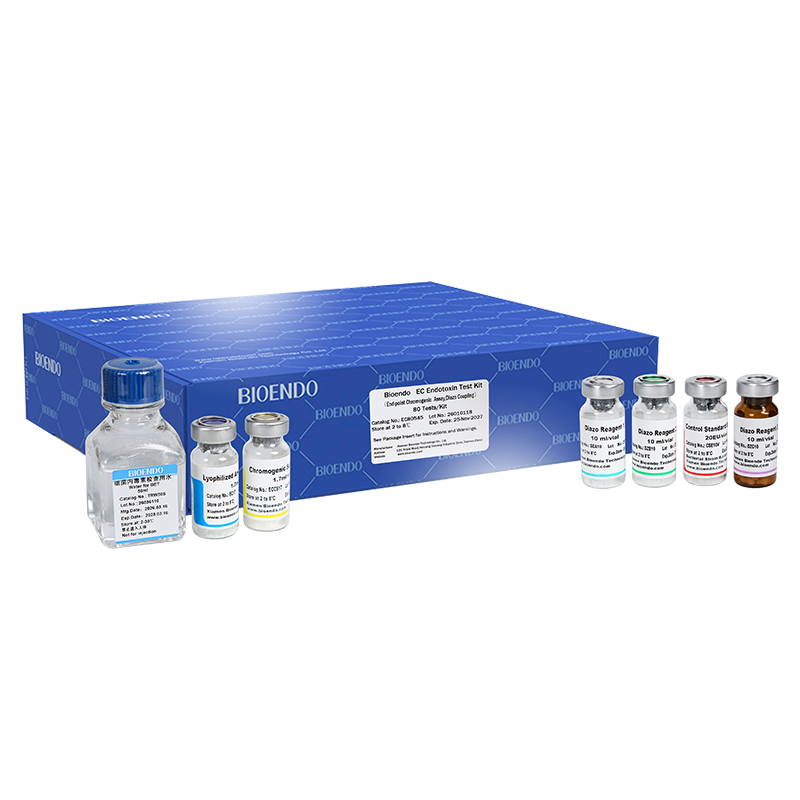
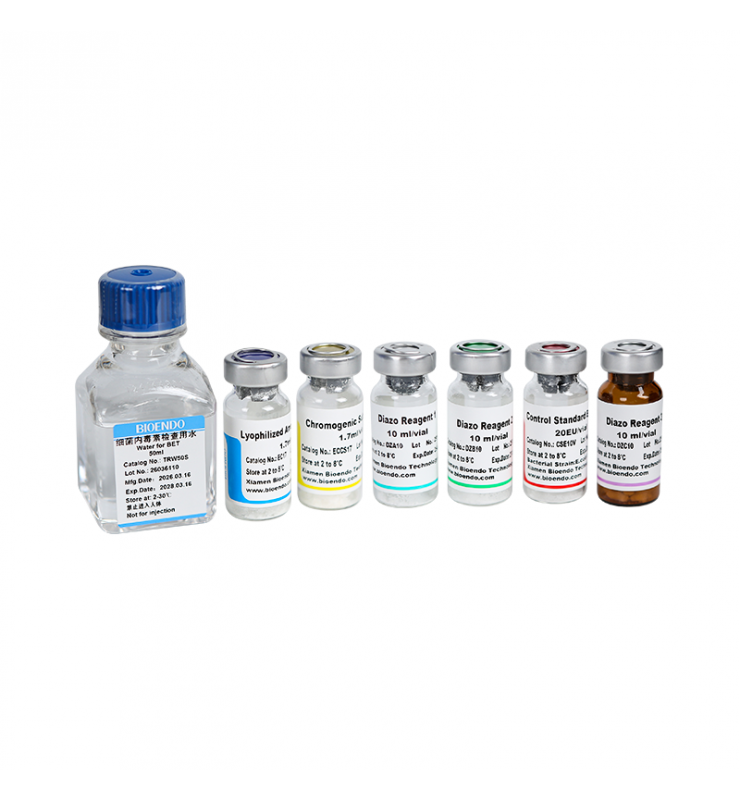
End-point Chromogenic Endotoxin Assay (545nm) determine the amount of endotoxin in sample by using synthetic chromogenic substrate and diazo reagent to make LAL solution become rosy. Relevant reactions are done in tubes, and results will be analyzed in microplate reader at 540nm. Equipment like ELx808IU-SN, Venus96T, Venus96K could be used to develop endotoxin detection with End-point Chromogenic Endotoxin Assay (545nm).
| Catalog No. | Description & Kit Contents | Sensitivity Range |
| EC32545 | 32 Tests/Kit 2 Lyophilized Amebocyte Lysate, 1.7ml/vial; 3 Water for BET, 50ml/vial; 2 CSE; 2 Chromogenic Substrate, 1.7ml/vial; 2 Diazo Reagent 1, 10ml/vial; 2 Diazo Reagent 2, 10ml/vial; 2 Diazo Reagent 3, 10ml/vial | 0.1-1 EU/mL |
| EC32545S | 0.1-1 EU/mL;0.01-0.1 EU/mL | |
| EC80545 | 80 Tests/Kit 5 Lyophilized Amebocyte Lysate, 1.7ml/vial; 4 Water for BET, 50ml/vial; 5 CSE; 5 Chromogenic Substrate, 1.7ml/vial; 5 Diazo Reagent 1, 10ml/vial; 5 Diazo Reagent 2, 10ml/vial; 5 Diazo Reagent 3, 10ml/vial | 0.1-1 EU/mL |
| EC80545S | 0.1-1 EU/mL;0.01-0.1 EU/mL |
The sensitivity of Lyophilized Amebocyte Lysate and potency of Control Standard Endotoxin are assayed against USP Reference Standard Endotoxin. The Lyophilized Amebocyte Lysate reagent kits come with product instruction, Certificate of Analysis, MSDS.
Note: For other sizes/specifications not listed above, please contact our customer service team.
Email: Eve@bioendo.com
Tel: +86 18065928551
HIGH SENSITIVITY
0.01–0.1 or 0.1–1 EU/mL
Provides sensitive endotoxin quantification with detection ranges of 0.01–0.1 EU/mL or 0.1–1 EU/mL.
CHROMOGENIC METHOD
Quantitative LAL Assay
Determines endotoxin concentration by measuring chromophore release through a colorimetric reaction.
ANTI-INTERFERENCE
Diazo Reagent Reduces Interference
Diazo reagent helps reduce interference from colored samples such as plasma and serum.
RAPID TESTING
Results in 16 Minutes
Complete detection process can be performed within 16 minutes, improving laboratory efficiency.
READER COMPATIBILITY
Supports Multiple Detection Systems
Applicable with ELx808IUSN, Venus96T, Venus96K, GalaxyFA717 and EpOCH2NS-SN detection systems.
RELATED EQUIPMENT
Compatible Endotoxin Detection Systems
Compatible instruments support different endotoxin detection workflows, from routine laboratory testing to fully automated analysis.
PRODUCT
DESCRIPTION
Full Wavelength Absorption Light Bacterial Endotoxin Detector
Fluorescent Endotoxin Detection Instrument
Multifunctional Endotoxin Detector
Bacterial Endotoxin Detector
Intelligent Fully-Automatic Endotoxin Detection System
Phoenix Q9
Intelligent Fully-Automatic Endotoxin Detection System
Modular Intelligent Fully-Automatic Endotoxin Detection System
Click the product name to view product details.
FREQUENTLY ASKED QUESTIONS
Standard Curve & Sample Testing
Q1
Why is the standard curve not well made?
Each kit can produce two standard curves, either 0.1–1.0 EU/ml or 0.01–0.1 EU/ml; taking 0.1–1.0 EU/ml as an example: the corresponding endotoxin absorbance values are approximately 0.1, 0.25, 0.5, 1.0 EU/ml.
(1) Carefully read the instructions (especially the endotoxin standard instructions, and if it is a blood sample, also the sample treatment solution instructions) to ensure all steps are correct.
(2) Is the endotoxin fully shaken? Simply shaking by hand or mixing on a shaker is insufficient; use a vortex mixer for thorough mixing.
(3) Is the horseshoe crab reagent shaken vigorously? The reagent must be used within 10 minutes. Prepare endotoxin working standards and samples first, then dissolve the reagent. After dissolving, mix gently and let stand for 20 seconds.
(4) Are incubation time and temperature controlled? If the incubator is not effective, use a water bath. To control incubation time, add samples quickly while avoiding contamination (cover the tube with aluminum foil during incubation; no need for sealing film, which saves time).
Q2
How to test samples?
Initial sample testing requires preliminary experiments to determine the concentration range. It is recommended to first use the 0.1–1.0 EU/ml standard curve to determine sample concentration. If the sample concentration exceeds the upper limit of the standard curve, dilute the sample; if it falls below the lower limit, use the other standard curve (0.01–0.1 EU/ml). After selecting the standard curve, perform interference tests to verify experiment reliability (refer to the instructions or Chinese Pharmacopoeia).
Q3
Which kit to use for blood samples?
Generally, plasma samples use the horseshoe crab reagent kit with azo reagent chromogenic substrate (test tube method), which has strong anti-interference ability. Customers should treat samples with the sample treatment solution before testing. (Sample treatment solution and anticoagulant reagent kit are provided. For serum samples, inform customers that detection may be less effective and plasma is recommended.)
Q4
Can detection be done with a microplate reader?
After the reaction ends, detection can be done with a spectrophotometer at 545 nm wavelength or by taking 200 µl for detection with a microplate reader. If 545 nm is unavailable, use 540 nm. (Note: Do not detect at 690 nm.)